Biographical Sketch
Family
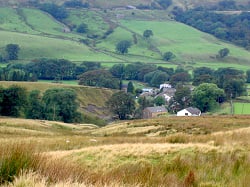
Michael's father and mother came from the small hamlet of Outhgill in northern England. Outhgill was located in a beautiful but rugged mountainous region and life there was very hard. Michael's father, James, was a blacksmith and his mother, Margaret was a maidservant. They were married in 1786 and their first two children, Elizabeth and Robert, were born in Outhgill.
Early Life
James and Margaret belonged to a small Christian group known as the Sandemanians. The Sandemanians were a close knit Bible-based sect that opposed any union of church and state. In 1791 the family moved to Newington Butts on the outskirts of London. James set up a blacksmith shop there and they attended a Sandemanian church nearby. James was often in poor health and the family struggled to get by. Michael was born on September 22, 1791. Little is known of Michael's early life, but we do know that his education was meager. Michael once stated
My education was of the most ordinary description, consisting of little more than the rudiments of reading, writing, and arithmetic at a common day-school.
First Job
In 1796 the family moved to Jacob's Well Mews near downtown London. They lived over a coach house and James worked as a smithy for a fellow Sandemanian. Because of his health problems, he could only work part time. In 1804, at age 12, Michael went to work for a nearby bookseller and bookbinder named G. Ribeau delivering and picking up newspapers. In those days most people could not afford to buy a newspaper, so they paid a small amount to rent a paper for a while. The paper was then picked up and delivered to another person. Michael impressed his employer with his willingness to work hard. Within a year Michael was taken on as an apprentice at the book shop. Here he learned the craft of binding books. Some of the books he bound are still in existence today — a tribute to his skill as a bookbinder.
Reading
Through this job Michael had access to many books and spent much of his free time reading. One of the books that impressed him was The Improvement of the Mind by the famous hymn writer Isaac Watts. From this book he learned, among other things, to keep a journal of his thoughts and work. This Michael did throughout his life. Watts also encouraged his readers to attend meetings in a field of interest and to correspond with others in this field. Another writing that attracted Michael's attention was a an article in the Encyclopedia Britannica entitled History and Present State of Electricity by Joseph Priestly. This article stimulated a life-long interest in electricity. Another pivotal book for Michael was Jane Marcet's Conversations in Chemistry. This book had the great merit of linking chemistry and electricity.
Joins Science Society
In response to Watt's suggestion, Michael began attending a newly formed group called the City Philosophical Society. Michael's brother Robert payed for his admission ticket. This group met in the home of John Tatum, a local silversmith. Here he received his first scientific instruction. Tatum and other members of the group would give lectures on subjects they were interested in. Michael took careful notes and later bound them. Michael also engaged Edward Magrath, the secretary of the society, to tutor him in writing skills. These lessons continued at two hours per week for nearly seven years. Michael met one of his closest friends, Benjamin Abbott, at the society meetings. They frequently met and talked about the lectures. The two corresponded with each other throughout Michael's career as a scientist.
First Laboratory
Mr. Riebau allowed Michael to use one of his workrooms as a laboratory at night. Using crude equipment Michael attempted to repeat many of the experiments he had read or heard about. He used some of his meager earnings to purchase two glass jars. One he converted into a Leyden jar (the early form of a condenser or capacitor for storing electric charge). He used the other to construct a crude device for generating static electricity. It consisted of a leather pad rubbing against a rotating glass bottle. Later Faraday constructed a simple battery patterned after the original discovered by Alessandro Volta (stacks of alternating dissimilar metals separated by moist cardboard).
Attends Davy Lectures
As the end of his apprenticeship grew near, Michael made up his mind to pursue a career in science rather than bookbinding. He wrote a letter to Sir Joseph Banks, president of the Royal Society, asking for any position however humble. He never received a response. After many attempts to follow up on this letter, he was told that his letter didn't require a response. Michael was very discouraged. However, in the winter of 1811--1812 Riebau showed some of Michael's beautifully bound notes to a customer who was so impressed that he passed them on to his father, William Dance. Dance was a prominent musician and also a member of the Royal Institution. As a result, Michael received tickets to the last four lectures at the Royal Institution given by the prominent chemist Humphrey Davy. In addition to being an outstanding experimenter Davy was also a gifted lecturer and showman. Michael was fascinated by the lectures and took careful notes. These notes he bound into a 386 page volume that contained descriptions of all the experiments as well as diagrams of the apparatuses.
Pursuit of Science
Michael had now finished his internship and went to work for Henry de la Roche, a very unpleasant man to work for. He was now more anxious than ever to get out of the bookbinding business. Encouraged by Dance and Ribeau, Michael wrote to Davy seeking his help in finding a job in science. He enclosed the bound volume of his notes on Davy's lectures. In October of 1812 Davy injured his eye in a laboratory explosion and needed someone to write up his experiments. Possibly on the recommendation of Dance, Davy hired Michael to be his secretary while his eye was recovering. This job lasted for only a few days and Michael returned to his job as a bookbinder. In December of 1812 Michael received this treasured letter from Davy
I am far from being displeased with the proof you have given me of your confidence & which displays great zeal, power of memory & attention. I am obliged to go out of Town & shall not be settled in Town till the end of January.
I will then see you at any time you wish.
It would gratify me to be of service to you. I wish it may be in my power.
I am sir
your obedient humble servant
H. Davy
Job at Royal Institution
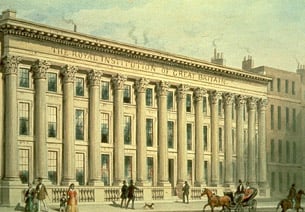
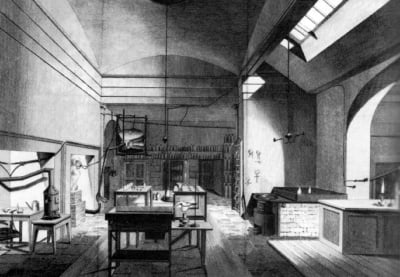
In March of 1813 Michael was surprised when a carriage arrived at his door and a footman delivered a message from Sir Humphrey Davy requesting his attendance the following morning at the Royal Institution. It turned out that one of the Laboratory assistants had been fired for brawling with the instrument maker and Michael was offered the job. He accepted at once even though the pay was less than he was receiving as a bookbinder. In addition to his salary he was given two attic rooms to live in and as much coal and candles as he needed for heat and light. He was also allowed to use laboratory equipment for his own experiments. Although Michael was excited, this was not a glamorous job. The post was later described as ‘Fire-Lighter, Sweeper, Apparatus-cleaner and washer’ or ‘Fag and Scrub’. It was a low level servant's job. A picture of the Royal Institution is shown in Figure 3 and Figure 4 shows the laboratory where Faraday worked.
Trip with Davy
Six weeks after Michael was employed by the Royal Institution, Davy resigned his professorship and became an honorary professor. William Brande succeeded him as professor of chemistry and Faraday then became his assistant. A few months later Davy proposed a scientific tour of Europe that included travel through France even though France and Britain were at war. Napoleon was intrigued by the idea and granted him safe passage through France. Davy invited Faraday to come along as his assistant. Michael gladly accepted since he had never traveled more than a few miles from his home. Shortly before they left, Davy's valet backed out of the trip and Michael had to assume his duties as well.
They left London on October 13, 1813 and traveled through France, Italy, and Switzerland. While in France they attended a lecture by the famous chemist Joseph Louis Gay-Lussac. They also experimented with a new substance presented to them by André-Marie Ampère, a pioneer in electrical research. This crystalline substance produced a violet vapor when heated. Davy determined that this substance was a new element and named it iodine (from a Greek word meaning violet-colored).
Traveling on to Italy, they performed experiments in Genoa on a fish called the torpedo — today known as an electric ray because of its ability to administer an electric shock. From there they went to Florence where they used a large lens to focus the sun's rays on a diamond and cause it to burn. Since the only by-product was carbon dioxide, they determined that diamonds are a form of carbon.
Traveling on to Pavia, Davy and Faraday visited with Alessandro Volta, the inventor of the battery and the greatest living expert on electricity. Afterwards Davy and Faraday spent a three month holiday in Geneva where Michael met Auguste de la Rive, a professor of physics. The two became lifelong friends and corresponded with each other frequently. Although they planned to continue on to Constantinople, political unrest caused them to cut the trip short and the party returned to London on April 23, 1815.
Although Faraday had frequent clashes with Lady Davy who refused to consider him as anything more than a servant, the trip left a lasting impression on Michael. He was exposed to exciting new areas of science and met many of the World's leading scientists. On his return to London Michael was re-appointed to the Royal Institution and named superintendent of the laboratory apparatus and its mineralogical collection.
Works with Davy
Although Davy was no longer the professor of chemistry he still performed experiments at the laboratory and was Michael's tutor for several years. Faraday worked with Davy to develop a safety lamp for coal miners. The flame from conventional lamps would often cause the methane gas present in the mines to explode. Davy and Faraday showed that a wire gauze placed around the flame would allow air to come in, but would not allow the flame to spread to the surrounding atmosphere.
First Published Paper
Faraday's first published paper was an analysis of Calcium Hydroxide, known as caustic lime. From 1818 to 1822 Faraday performed research on alloys of steel. By 1819 he had developed the reputation of being the leading analytic chemist in Britain. He was often called upon to analyze various clays and metal alloys. In 1821 Faraday turned his attention to organic chemistry and compounds containing carbon. He was puzzled by the fact that chlorine didn't seem to combine with carbon as it did readily with other non metals. His research led to the discovery of tetrachlorethene a solvent used in dry-cleaning.
Liquefication of Gases
During the period 1823--1824 Michael discovered how to liquefy a number of gases. Davy, who was the first to show that chlorine gas was an element, had combined chlorine with water to form a solid he called a “hydrate.” He suggested that Faraday heat the solid in a sealed tube. Faraday carried out the experiment which surprisingly produced an oil-like liquid. Faraday showed that the oil was in fact liquid chlorine. The chlorine gas produced by the heating had been subjected to a large pressure since it was confined to the tube. The pressure had liquefied the gas. Within weeks Faraday was able to liquefy a large number of gases using pressure. Years later he combined pressurization with cooling to produce solid carbon dioxide (“dry ice”).
Marriage
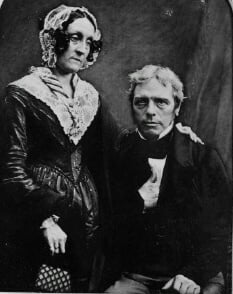
In June of 1821 Michael married Sarah Barnard, whose family belonged to the Sandemanian church. Although they never had any children, the marriage seems to have been a very happy one. Many years later Michael wrote of himself
On June 12, 1821, he married --- an event which more than any other contributed to his earthly happiness and healthful state of mind. The union has continued for twenty-eight years, and has nowise changed, except in the depth and strength of its character.
A picture of Michael and Sarah many years later is shown in Figure 5.
Split with Davy
The year 1821 also signaled the beginning of a controversy that would cause a split between Faraday and Davy. In April of that year Dr. Wollaston visited the laboratory and had some discussions with Davy on how electrical currents might be used to produce mechanical rotations. Faraday was present for part of these discussions. Afterwards Faraday arrived at a solution that was different from that proposed by Wollaston and was able to construct a simple electric motor. Before publishing his results Michael attempted to contact Wollaston, but he was out of town. Michael went ahead and published his results without first showing his paper to Wollaston. A short time later Davy implied in a public meeting that credit for this discovery should actually be given to Wollaston. Faraday apologized to Wollaston for publishing the article before showing it to him, but he still maintained that he had arrived at this discovery independently. Wollaston accepted his apology, but Davy was not so generous.
Elected to Royal Society
In 1823 Michael was proposed for membership in the Royal Society, one of the most prestigious scientific organizations in the world. The only opposition to his appointment was from Davy who was then president of the society. In spite of Davy's opposition Michael was elected to the society in 1824. The reasons for Davy's actions are not clear. Perhaps he was jealous of Michael's achievements and popularity. However, Faraday never had an unkind thing to say about Davy.
Director of Laboratory
In 1825 Michael became the director of the Laboratory at the Royal Institution. In this year he also discovered the important chemicals Benzene and Isobutene and established the chemical formula for Naphthalene. Besides their use as fuels, Benzene and Naphthalene are important building blocks in the pharmaceutical industry. Also in 1825, the government chose him to lead a project to improve the quality of optical glass. This project lasted through 1830. His work in this area led to some important changes in the chemical composition of optical glass.
Science Lectures
Michael was also very interested in scientific education. He felt that it was the duty of scientists to educate the general public so they could make intelligent decisions on public issues involving science. In 1826 he started the regular Friday evening lecture series at the Royal Institution that continues to this day. The lecture series became a major social event in London and frequently drew 700--1000 attendees. In 1827 he also started the annual Christmas lecture series for children. This series involved six lectures each year that were designed to stimulate in the young audience an interest in science. Michael himself gave many of these lectures. Probably the best known was his series of lectures on The Chemical History of a Candle that has been put in book form. Through hard work Michael became a very skilled communicator. In his lectures he often used humor, he avoided technical terms whenever possible, and he never talked down to his audience. He also made frequent use of demonstrations to illustrate the points he was making. In 1829 Faraday was appointed Professor of Chemistry at the Royal Military Academy in Woolwich. This position required that he give 25 lectures a year. He held this position for 25 years while still maintaining his position at the Royal Institute.
Electromagnetics
Faraday's greatest discovery, that of electromagnetic induction, was made August 29, 1831. It was known at the time that electric currents could produce magnetic effects. Faraday's discovery showed that changing magnetic fields could produce electric currents. From this discovery he was able to build the first electric generator. This discovery was also the basis for the electric transformer. Faraday's discovery can be taken as the beginning of the electrical industry as we know it today. Faraday also began to speculate on the nature of the phenomenon he had observed. At the time, most scientists considered electric and magnetic forces as action-at-a-distance effects between electric charges or magnetic poles, similar to those in Newton's gravitational theory. Faraday believed that there must be something going on in the region between the poles or charges. He introduced the idea of electric and magnetic fields surrounding current carrying wires and magnets. This idea was later picked up by James Clerk Maxwell and led to his famous electromagnetic equations. Faraday illustrated the idea by placing a magnet under a sheet of paper on which was sprinkled iron powder. The powder formed into a series of curved lines converging on the poles of the magnet. He called these lines lines of force. The Field concept is used throughout physics today.
Unity of Nature
Michael had an enduring belief in the unity of nature. This belief was a natural consequence of his conviction that all things were created by God. It was this belief in the unity of physical phenomena that had led him to investigate the strong link between electricity and magnetism. Another fundamental question next attracted his attention. There were a number of effects that had been classified as electrical. There was the static electricity generated by rubbing an amber rod with a piece of silk; there was the electrical discharge known as lightening; there were the electrical shocks generated by animals to repel their attackers; there were the electrical currents produced by the first batteries called voltaic cells. Michael wondered if all of these effects were in reality the same. By 1832 he had determined that this was the case by testing these various electrical sources for their ability to produce magnetic effects and their ability to decompose chemicals.
Electrolysis
In 1833 his study of electrical decomposition of chemicals led to the formulation of Faraday's First and Second Laws of Electrolysis. Many of the terms now used in Electrochemical science were either invented or popularized by Faraday. These include electrolysis, the process of decomposing a chemical solution by electricity; electrolyte, the solution being decomposed; electrode, the conductor by which the current enters or leaves the solution; cathode, the negative electrode; anode, the positive electrode; ion, a charged particle in the solution; cation, an ion discharged at the cathode; and anion, an ion discharged at the anode.
Lighthouses
In addition to his laboratory research, Michael was also involved in the application of science outside the laboratory. In 1836 he was appointed the scientific advisor to Trinity House, the body responsible for maintaining the lighthouses along the coast of England. He held this position until 1865. He advised them on methods of lighting (including the merits of electrical lighting), on fog signals, on the manufacture of lenses, on efficient heating, and on ventilation. His duties involved extensive travel to remote areas.
Capacitors and Dielectrics
Since Michael believed that electrical forces were not due to some action at a distance but involved the medium in between charges, he began to study the effects of placing insulating materials between charged surfaces. In 1837 he performed several experiments on a pair of spherical capacitors, each consisting of two concentric spherical conductors separated by a small gap. He placed a charge on the smaller sphere of one of the capacitors and then made an electrical connection between this sphere and the small sphere of the second capacitor. He found that the charge was shared equally by the two spheres. He then placed an insulating material in the gap between the spheres in one of the capacitors and again connected the two capacitors. He found that the capacitor containing the insulating material always had a greater charge than the one that didn't. He was able to study the difference between various insulating materials using this method, and arrived at a material constant for each material now called the dielectric constant. A picture of one of Faraday's spherical capacitors is shown in Figure 6.

Health Fails
In 1838 Faraday's health began to fail due to a combination of fatigue and rheumatism. The worst effect was a frequent loss of short-term memory. In 1839 he was forced to take a holiday. He spent about eight months in Switzerland. In 1840 he was appointed to be an Elder in the Sandemanian church. For the next four years he had to abandon nearly all of his research projects. He still gave some lectures during this period, but most of his time was spent in leisure activities and rest.
Light and Electricity
By 1845 Michael was much better and again resumed his research. He began to wonder if light and electricity were in some way related. He subjected plane-polarized light to a very strong electric field, but could detect no change in its polarization. He then turned to magnetism using the most powerful electromagnet he could find. He suspended a piece of very fine optical glass (obtained from his previous research on optical glass) between the poles of this very strong electromagnet and passed plane-polarized light through it. He observed a rotation of the plane of polarization of the light. This result is now known as the Faraday effect. This was the first hint of a connection between electromagnetism and light, a connection that was later expanded by James Clerk Maxwell. Michael announced his results to the Royal Institution and the Royal Society in November of 1845.
Diamagnetic Materials
In November of 1845 he also discovered another important result. When he suspended a bar of his optical glass between the poles of the powerful electromagnet, the bar rotated until it was perpendicular to the line joining the two poles. This was different from the behavior of materials such as iron. It was like the bar of material was being repelled by the two poles of the electromagnet. He called materials exhibiting this behavior diamagnetic. Bars of materials such as iron and nickel aligned themselves parallel to the line joining the two poles. These materials he called paramagnetic. He tested many materials and found that bismuth was the most strongly diamagnetic. He later studied gases and found that many common gases are diamagnetic. Oxygen, however, turned out to be strongly paramagnetic.
Consultation
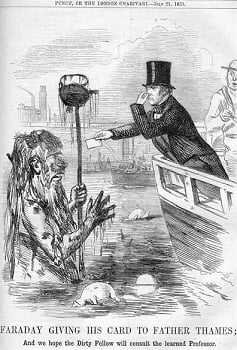
Michael's health continued to deteriorate. His short-term memory loss became worse and worse. During the last two decades of his life he spent much of his time providing consultation to industry and government. For example, he worked for the Electric Telegraph Company studying the effects of submersion on the insulation of electric cables. He also studied the effects of pollution on works of art, the preservation of ships' timbers, and the disinfection of prisons. His work on lighthouses with Trinity House actually increased during this period. He also used his influence to address public issues. In a letter to the Times (July 7, 1855) he complained about the condition of the Thames river that runs through London. While traveling down the river on a steamboat he observed that the river was a brown opaque fluid and smelled like a sewer. To test the opacity he dropped pieces of a white card into the river at several spots. He said that when the pieces entered the water edgewise, the bottom portion disappeared from view before the top part was under water. He urged the officials in charge to take steps to eliminate this condition before it was too late.
An editorial cartoon based on this letter of Faraday is shown below in Figure 7.
End of Career
In 1857 Faraday was offered the presidency of the Royal Society, the most prestigious scientific office in the world. He declined. Faraday had little interest in worldly honors, having turned down the offer of knighthood several years earlier. He told his assistant, John Tyndall I must remain plain Michael Faraday to the last. Although Michael never sought favors from Queen Victoria, he was highly regarded by Prince Albert. The Prince sometimes attended his lectures. In 1858, at Albert's request, Queen Victoria offered Faraday one of her houses near Hampton Court. At first Michael and Sarah resisted, but in 1862 they made the house at Hampton Court their home. Faraday gave his last Christmas lecture in 1861 and his last Friday night lecture in 1862. In 1865 he resigned his position as elder in the Sandemanian church and also his position as superintendent of the house at the Royal Institution. He also severed his long time relationship with the Trinity House.
End of Life
Michael approached the end of his life with a quiet confidence.
He particularly enjoyed meditating on the 23rd Psalm (The Lord is my Shepherd; I shall not want …) and the 46th Psalm (God is our refuge and strength …). He died on August 25, 1867, sitting quietly in his study chair. His funeral took place at Highgate Cemetery and was attended only by his family and a few close friends. This was as he requested. At the head of his grave was a simple stone with the words
Michael Faraday
Born 22 September 1791
Died 25 August 1867
Awards and Honors
Faraday received numerous awards and honors during his lifetime.
He was elected to membership in close to 100 scientific societies throughout the world. These included the French Academy of Sciences (one of eight foreign members), the Cambridge Philosophical Society, the Royal Society of London, the Imperial Academy of Sciences (St. Petersburg), the Royal Society of Edinburgh, the Imperial Academy of Sciences (Vienna), and the Royal Academy of Sciences (Berlin). From the Royal Society in London he received the Royal Medal twice (1835 & 1846), the Copley Medal twice (1832 & 1838), and the Rumford Medal (1846). He also received an honorary Doctor of Civil Law degree from Oxford (1832) and was appointed to be a Senator of the University of London in 1836. Michael never sought any of these honors, but he treasured them greatly.
+++++